There is a better way to build it.

Every organisation starts the same way: a few pieces, laid out with care. Then it grows. Models bolted on, pilots that never shipped, a stack nobody owns. We don't take the blocks away. We steady them, then show you how to build.

what we do

AI consulting and IT services, applied honestly.

Buddhyantra is a small, deeply technical team of architects and engineers. Not a sales-led shop — the people who scope your work are the people who build it. We do two things that belong together: the channel your organisation meets its people through, and the AI that manages everything coming back through it.

connect

Custom made apps people will actually use

Web and mobile applications that put a citizen in front of a government department, or a customer in front of your business, without a middleman. Shaped around the process you actually follow — and built in the language the person on the other end reads, types and speaks in. Legacy systems get carried across, not ripped out.

automate

AI for your business or organisation

Open a channel and it fills up. We build the AI that manages what comes back: classifying and routing to the right desk, triaging what is urgent, summarising a thread before a human opens it, and chasing the follow-up nobody has time to chase. Applied where it earns its place, not everywhere at once.

decide

Data engineering on the customer data you already hold

Most organisations are paying to store years of operational and customer data that answers no questions. We do the pipelines, the cleaning, the modelling and the warehouse — then the part that pays for it: forecasts, patterns, and the decisions that were quietly being made on instinct.

advise

IT consultancy for how you ship

SDLC review, repository restructuring, low-code tool selection, and AI training for your own engineers. We start by finding where the work genuinely hurts — the handoffs, the merge queue, the release nobody wants to run — and build process around that instead of around a diagram.

how it works

Any channel. Any language. One system.

A citizen with a grievance is not going to log into a portal and fill a form in English. They will send a two-minute WhatsApp voice note in Malayalam, or photograph a paper application and send that instead. Multi-channel and multilingual intake is the whole problem — and it is the part most systems quietly push back onto the person who needed help.

  1. 01 — in

    It arrives however they’re comfortable

    A WhatsApp voice note. A photo of a filled-in form. A phone call, an SMS, an email, a web form, or a walk-in at the counter. Nobody is asked to change language or channel in order to be heard, and no one channel is the “real” one.

    • WhatsApp
    • voice note
    • phone call
    • SMS
    • email
    • web form
    • scanned paper
  2. 02 — understood

    Speech and paper become something the system can act on

    Voice is transcribed in the language it was spoken, not translated into English first. Photographed forms, PDFs and letters are read into real fields. A rambling three-minute message becomes a subject, a department, a priority and a contact — with the original audio and scan kept beside it, because a transcript is evidence of a record, never the record.

  3. 03 — out

    The answer goes back the way it came

    Routed to the desk that can actually act, chased if it stalls, and answered on the same channel in the same language it arrived in. A petitioner who asked in Tamil is answered in Tamil — and the officer or the business owner replying never had to read or write a word of it.

  • മലയാളം Malayalam
  • हिन्दी Hindi
  • தமிழ் Tamil
  • తెలుగు Telugu
  • ಕನ್ನಡ Kannada
  • मराठी Marathi
  • বাংলা Bengali
  • English

Adding a language or a channel is configuration, not a rebuild.

products

Things we built, and still run.

Not demos. Software in daily use by the organisations it was made for — which is also why we keep supporting it long after the invoice cleared. Each one started as the same conversation: an office drowning in what the public sends it.

FilesTrace

Where is this file, what’s its status, and who did what to it?

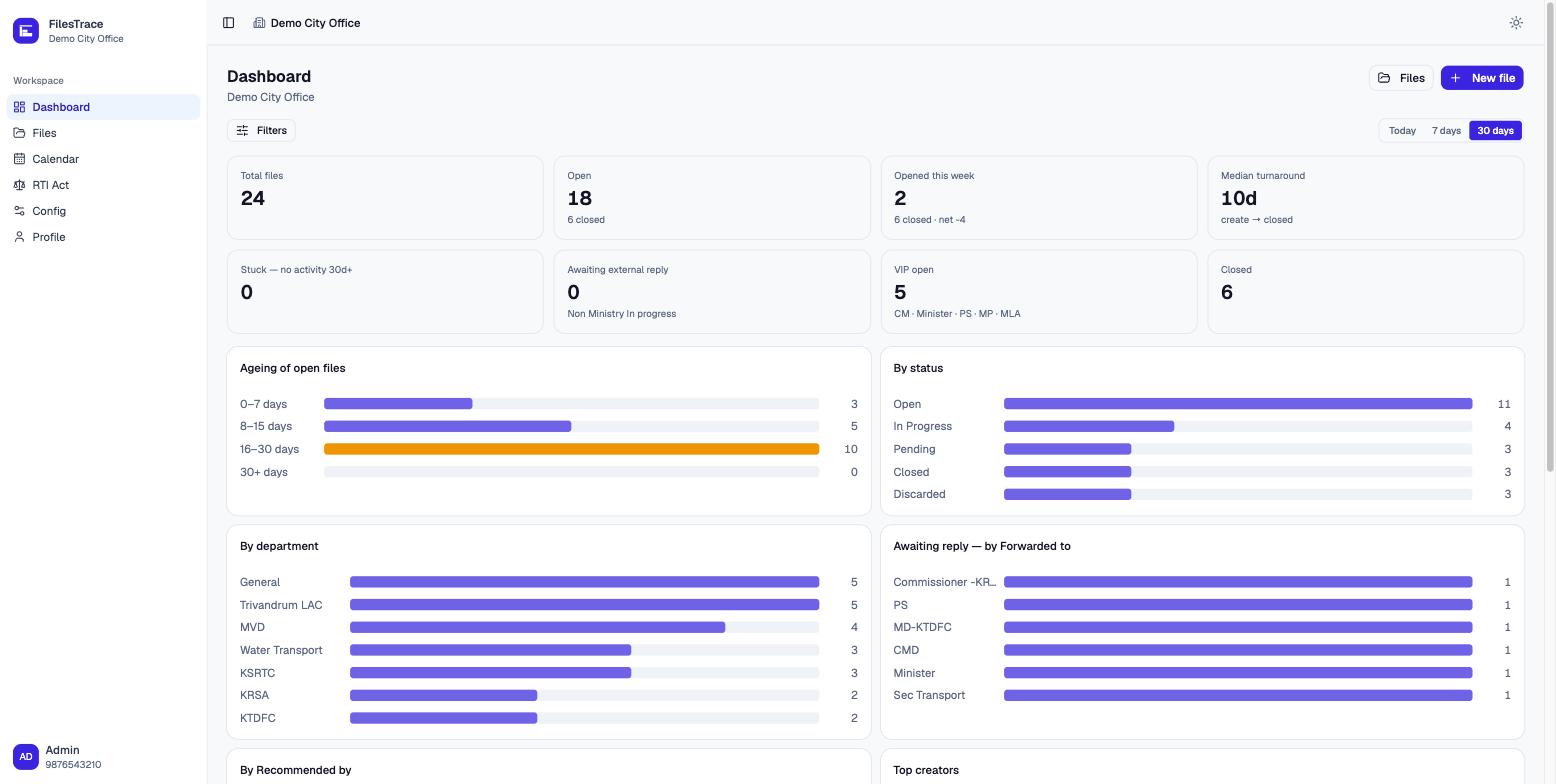
FilesTrace is file tracking for government departments and organisations that run on paperwork. A citizen sends a voice note or a photo of a form; it comes back as a summarised file with the department, status and next desk already suggested. Every file is filed under a department, moves through a status lifecycle the office configures itself, can be forwarded to another desk, carries its attachments, and keeps an append-only history of everything that happened to it. When a citizen rings to ask what happened to their application, the answer is on the screen instead of in someone’s memory.

  • Voice notes and documents transcribed, summarised by AI, with the department, status and next desk suggested
  • Departments, wards and a status lifecycle you set up yourself — no code, no support ticket
  • A history that records every comment, forward and status change, and never lets one be edited away
  • Group-based access that spans departments, plus a shared calendar and an RTI Act register
  • Self-hosted on your own PostgreSQL, mobile-first, with PDF exports that match the screen
More details
The FilesTrace dashboard: counts of total, open and closed files, median turnaround, an ageing breakdown of open files, and bars splitting files by status and department.

questions

The things people ask first.

Usually before the second email. Answered here so the first conversation can start somewhere more interesting.

What does Buddhyantra actually do?

Two things that belong together. We build the channel an organisation meets its people through — a citizen portal, a grievance app, a customer-facing service, in the languages those people speak. Then we build the AI that manages what comes back through it: routing, triage, follow-up, and the reporting that falls out of the data it generates.

Do you work with government departments?

Yes, and it is a large part of what we do. Public offices carry the hardest version of the problem: statutory deadlines, an audit trail that has to hold up, and a public that does not share one language. FilesTrace, our file tracking and RTI register product, came directly out of that work and is in daily use.

Which Indian languages do you support?

Malayalam, Hindi, Tamil, Telugu, Kannada, Marathi, Bengali and English are the ones we work in most, and adding one is a configuration job rather than a rebuild. It holds across channels as well as inside the database: a WhatsApp voice note in Malayalam is transcribed in Malayalam, triaged in Malayalam and answered in Malayalam, with no English round trip in the middle to lose the meaning.

Can people reach us on WhatsApp instead of a portal or a form?

Yes, and in our experience it is the channel that actually gets used. We take WhatsApp messages, voice notes, photographed paper forms, phone calls, SMS, email and web forms into the same queue, so the office works one list instead of seven inboxes. Voice becomes text in the language it was spoken, documents are read into fields, and the reply goes back out on the channel it came in on.

Do you build with low-code tools or write everything from scratch?

Whichever one is honest for the problem. Internal tools, approval flows and back-office screens are often faster and cheaper on a low-code platform, and we will say so. The parts that carry your differentiation, your scale or your audit trail get written properly. What we will not do is hand you a platform you cannot leave.

We already have years of customer data. Can you do something with it?

That is usually the fastest win available. Most organisations are paying to store operational and customer data that answers no questions. We do the data engineering — pipelines, cleaning, modelling, a warehouse you can query — and then the analysis: what the patterns say, what to forecast, and which decisions were being made on instinct.

Are you an AI company or an IT services company?

We are engineers who use AI where it earns its place. A great deal of what an organisation needs is ordinary IT services done well — a system that stays up, an integration that holds, a migration that does not lose records. We do that work, and we add AI to it when there is a real reason, not to have added AI.
start here

Tell us what isn't working.

Bring the messy version. A queue nobody is clearing, a helpline in one language for a public that speaks four, a stalled AI pilot, a vague board mandate. We'll tell you honestly whether AI is the answer.